 zedech
What AI Actually Looks Like Inside a Malaysian Business in 2026
Most people think AI for business means a chatbot on your website. The kind that asks "How can I help you?" and then sends you in circles until you give up and call the office anyway.
That's not what we're talking about.
We're talking about AI that actually runs parts of your business — quietly, reliably, in the background — while you focus on the work that only you can do.
Here's what that looks like in practice.

7:30 AM — Before You Even Open Your Laptop
Your AI has already been working. It checked your inbox overnight, flagged three emails that need your attention, and sent you a summary on Telegram:
"2 quotation requests (Syarikat ABC wants pricing for 50 units, Lee & Partners asking about monthly retainer). 1 complaint from yesterday's delivery — customer wants a replacement. Everything else is newsletters and receipts."
You haven't touched your laptop yet and you already know exactly what your morning looks like.
This isn't hypothetical. This is what happens when you connect an AI model like Claude to your email through MCP (Model Context Protocol) — the standard that lets AI talk directly to your business tools. Gmail, Outlook, Google Calendar, your CRM — Claude can read and act on all of them.
9:00 AM — Your WhatsApp Is Handled
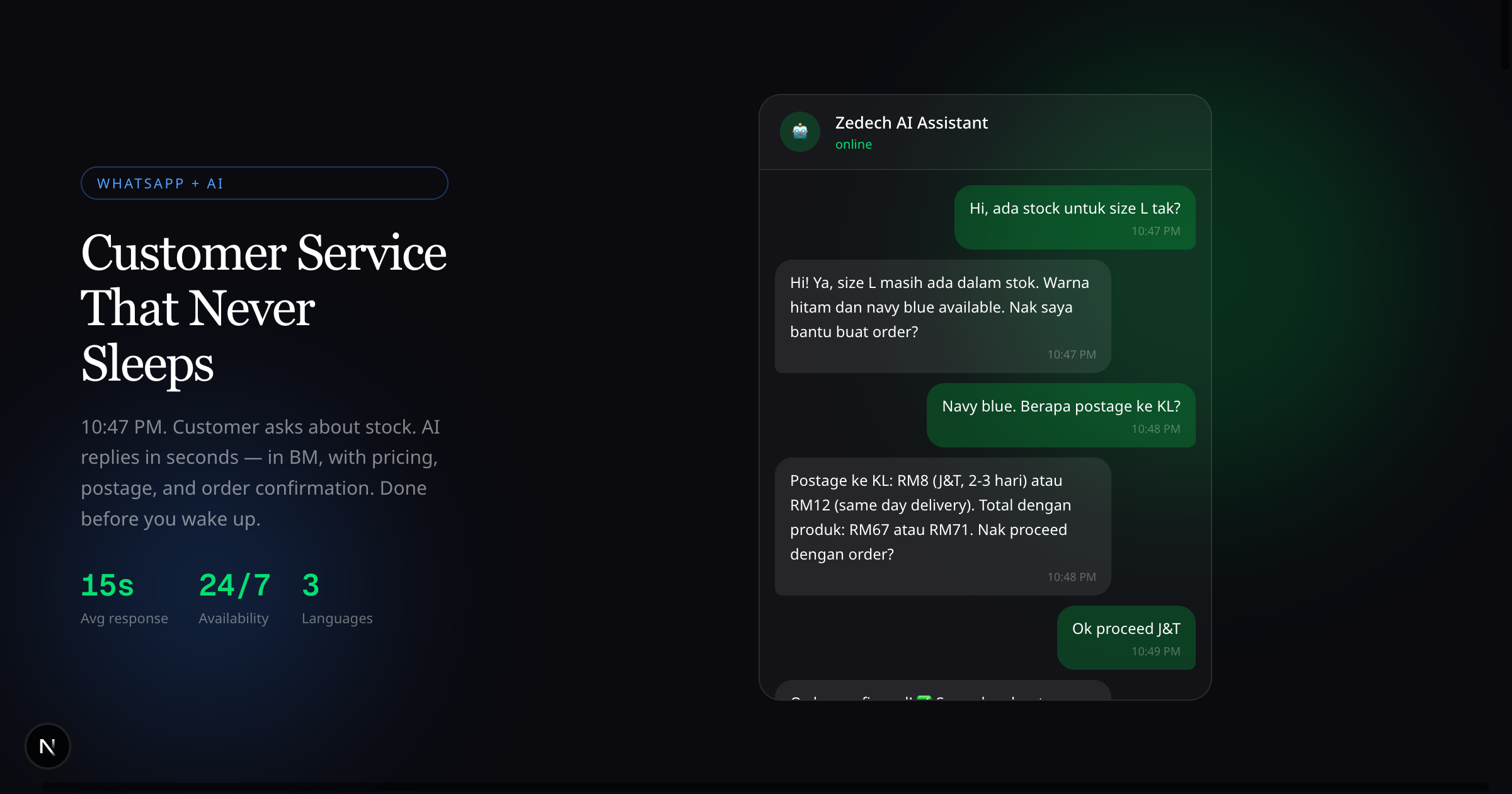
By the time you start work, your AI assistant has already replied to 12 WhatsApp messages that came in after hours. Not with generic "we'll get back to you" messages — with actual, contextual replies.
A customer asked about pricing? The AI pulled the latest price list and sent it. Someone wanted to book an appointment? The AI checked your calendar and offered three available slots. A supplier sent an invoice? The AI extracted the amount, matched it to the PO, and flagged it for your review.
Your team used to spend the first hour of every day clearing the WhatsApp backlog. Now they walk in and the backlog is already handled.
The numbers back this up — businesses using AI for customer service consistently report response times dropping from hours to under 15 seconds, with 55–70% of routine queries resolved without a human ever needing to step in.
11:00 AM — A Lead Comes In. AI Qualifies It Instantly.
Someone fills out your contact form. Within seconds — not hours, not tomorrow — the AI sends them a WhatsApp message:
"Hi Sarah, thanks for reaching out! Just a few quick questions so we can prepare the right info for you..."
It asks the qualifying questions you'd normally ask yourself. Budget range. Timeline. What they're looking for. By the time you check your dashboard, the lead is scored, categorised, and — if they're ready — already booked into your calendar for a call.
Research shows that responding to a lead within 5 minutes makes you 21 times more likely to qualify them compared to waiting 30 minutes. Most businesses take 12+ hours. Your AI takes 15 seconds.
2:00 PM — Content Gets Drafted
Your marketing person (or let's be honest — you, wearing the marketing hat) needs to post something on social media. Instead of staring at a blank screen, you tell the AI: "Draft 3 posts about our new service package. Tone: professional but friendly. Include a CTA."
Thirty seconds later, three drafts. In BM and English. You pick the best one, tweak two words, and post. What used to take an hour now takes five minutes.
The AI knows your brand voice because it's been configured with your business context — your services, your tone, your audience. It's not generating generic content. It's generating your content.
4:00 PM — The Report Writes Itself
End of day. You need the weekly sales summary for your partner. Instead of exporting CSVs, making charts, and writing paragraphs nobody reads — you ask the AI.
It pulls data from your spreadsheets, compares this week to last week, highlights what's up and what's down, and formats it into a clean summary. Done in 60 seconds. You forward it and move on with your evening.
10:00 PM — You're Off. The AI Isn't.
You close your laptop. The AI keeps going.
A customer WhatsApps at 10:47pm asking if you're open tomorrow. The AI checks your operating hours and replies. Another customer asks for a product spec sheet. The AI sends it.
At midnight, the AI runs its scheduled tasks — what's called a heartbeat. It reviews tomorrow's calendar, sends appointment reminders to your clients, checks for any overdue invoices, and prepares your morning briefing for when you wake up.
You're sleeping. Your business is still running.
The Technology Behind It
None of this requires custom software built from scratch. It's built on mature, proven tools:
Claude by Anthropic — one of the most capable AI models available today. It handles multilingual conversations (BM, English, Mandarin — even mixed in the same chat), reasons through complex business logic, and connects to over 6,000 apps through MCP.
OpenClaw — an open-source AI framework with 247,000+ stars on GitHub. It's the layer that connects Claude to your WhatsApp, Telegram, email, and business tools. It runs on your own hardware, so your data never leaves your office. It learns your preferences over time through its memory system, and it runs scheduled tasks through its heartbeat — checking in every 30 minutes to handle what needs handling.
MCP (Model Context Protocol) — the standard that lets AI talk to your existing tools. No need to switch software. No need to learn new apps. The AI plugs into what you already use.
We wrote a deeper explainer on how MCP works →
This Is Not Future Tech
Everything described above is running today, in real businesses. The tools are mature. The models are capable. The infrastructure exists.
The gap isn't technology — it's setup. Most business owners know AI can help, but they don't know where to start, what to connect, or how to configure it for their specific workflow. That's the hard part. That's what an AI agency does.
What It Takes to Get Here
A proper AI setup for a Malaysian business typically involves:
- Understanding your workflow — what you do daily, where time gets wasted, what tools you use
- Configuring the AI — setting up Claude with your business context, connecting MCP servers to your tools, configuring the WhatsApp/Telegram gateway
- Testing with real scenarios — not demo data, your actual business situations
- Tuning and refining — AI gets better the more it understands your business. The first week is good. The first month is significantly better.
The result? An AI system tailored to your business that works 24/7, handles the repetitive load, and frees you to focus on what actually grows the business.
Curious?
If anything in this post made you think "that would actually help my business" — let's talk. No pitch deck, no jargon. Just a conversation about your business and what's possible.
We're Zedech — an AI agency based in Malaysia. We set up AI systems using Claude and OpenClaw for businesses that want to operate at a higher level. We'd love to understand your business and see if we can help.